

Jade Bracelet Meaning: Protection, Luck, and the Quiet Weight of Tradition
· UpdatedWhat is the meaning of a jade bracelet?
A jade bracelet is traditionally read as a small daily marker — a stone worn on the wrist as a quiet reminder of balance, steadiness, and personal intention. In Chinese tradition the green of jade is associated with calm and protection; in broader interpretations, jade is simply the stone many wearers return to during difficult or transitional seasons. KAGAKI offers jade pieces as contemporary handmade interpretations, not as a religious artefact or healing object.
Featured piece ($29.77)
If you have a friend who wears jade, you may have noticed that they almost never talk about it. Jade is one of those stones that tends to live quietly on the wrist of someone who already has a relationship with it — a grandmother's bangle, a mother's gift, a piece they bought themselves the year their life changed. The people who wear jade often have a small, private reason for wearing jade, and they don't usually feel the need to explain.
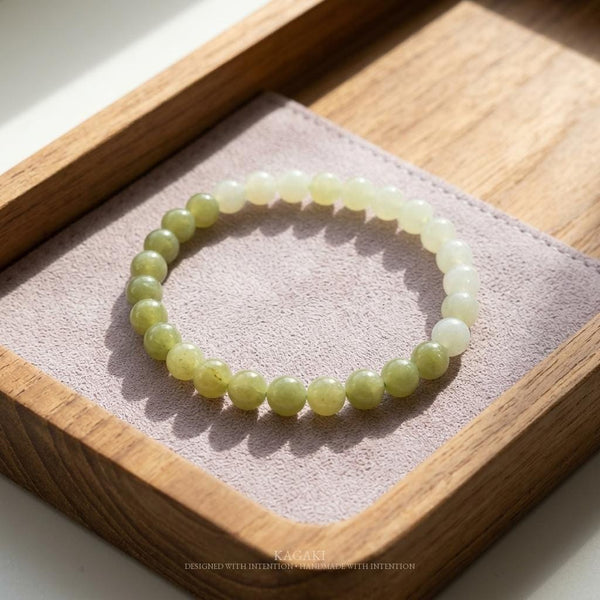
Meadow – 翠 | Green Jade Lucky Meditation Bracelet
Natural green jade, worn plain. A quiet piece for the wrist.
Explore the bracelet →That privacy is part of what jade means. It is one of the oldest stones in the world for a reason: it carries time. You don't only wear the stone you bought. You wear, faintly, the centuries of people who have worn jade before you.
This article is for the people who'd like to understand that — without pretending to a tradition that isn't theirs, and without flattening jade into another bullet point on a chart.
Jade bracelet meaning by color — at a glance
| Jade color | Traditionally associated with | Often chosen by |
|---|---|---|
| Green jade | Balance, growth, renewal, quiet vitality | The familiar register — most first jade pieces |
| White jade | Calm, clarity, soft protection | Wearers who want jade's symbolism without the visual weight of green |
| Black jade | Grounding, boundary, a stronger protective register | Often men, and anyone who wants jade in a darker, more anchored form |
| Lavender (purple) jade | Intuition, elegance, a more contemplative register | Rarer, and usually more expensive |
| Yellow jade | Warmth, optimism, abundance | Wearers who want jade to read warm rather than cool |
Each colour is unpacked slowly further down the page. None of these are health claims — they are the symbolic registers jade has carried in East Asian tradition.

A jade bracelet means a quiet daily form of protection, balance, and longevity — a piece of stone worn close to the wrist as both ornament and reminder, drawn from Chinese cultural tradition where jade has carried these symbolic weights for thousands of years.
This guide covers the layered meaning of jade bracelets across colors and forms, the difference between religious and personal symbolic wear, and how to choose a jade piece as a daily companion or a gift.
Jade bracelet meaning, in plain terms
A jade bracelet, in most contemporary contexts, is symbolically associated with balance, protection, harmony, and longevity. In East Asian cultures — Chinese, Japanese, Korean, and others — jade has been worn for thousands of years as both a personal adornment and a symbolic object, often passed down through families, often given at significant moments. In the West, jade has been worn for the same reasons people have always worn meaningful stones: as a small daily reminder of something that matters.
Jade is not magic. It does not guarantee luck, prevent harm, or grant longevity. What it does, when worn with care, is what most meaningful objects do: it carries a relationship between the wearer and the meaning they've chosen to keep close.
Jade bead bracelet meaning
A jade bead bracelet carries the same traditional reading as any jade piece — balance, protection, longevity — but held in many small stones rather than one solid ring. Each bead marks a repetition, which is why beaded jade is often chosen by people who count breaths, or who simply want something steady to touch during a long day.

Jade bracelet benefits, honestly stated
The honest benefits of wearing a jade bracelet are traditional and personal rather than medical: a long East Asian association with calm, protection, and steadiness; a cool, substantial stone that acts as a small physical anchor for attention; and the quiet sense of carrying a meaning you chose. Jade has been worn this way for millennia — as a companion stone rather than a cure. We do not claim health effects; what wearers most often describe is the steadying habit of touching the stone during a long day, the way the bracelet warms to the skin, and the feeling of wearing something with a lineage. Those are real, and they are enough.
Green jade bracelet benefits
Green is the colour most people mean when they say jade, and the benefits of a jade bracelet in green are traditional rather than medical: a long East Asian association with balance, growth and renewal, plus the cool weight of the stone itself working as a small physical anchor for attention through an ordinary day.
Chinese jade bracelet meaning — a respectful note
Jade has held deep cultural significance in East Asia — particularly in Chinese tradition — for over five thousand years. In Confucian thought, jade was associated with virtue and moral character. In many families, a jade pendant or bangle is given to a child at birth, worn through life, and passed to the next generation. In ritual and ceremonial contexts, jade has been associated with protection, harmony with the natural world, and the kind of quiet endurance that outlives a lifetime.
KAGAKI is a contemporary ritual jewelry studio. We make handmade jade bracelets that draw from this long conversation respectfully, but we do not claim to speak for it. The handmade jade pieces we make are inspired by the symbolism of jade — balance, protection, longevity — and made for modern life. They are not religious artifacts. They are not heirloom replicas. They are small, contemporary objects of intention, and that's how they're best understood.
If jade has personal cultural meaning for you and your family, your relationship to it precedes anything we could write. If it doesn't, you're still welcome to wear it — quietly, without performing a tradition you don't belong to, and with a small awareness that the stone has a history older than the language we're using to talk about it.
Jade bracelet colors and what they mean
Jade is most often green, but it also occurs in several other natural colors. Each is associated with a slightly different symbolic register.
- Green jade — the most familiar. Associated with balance, growth, renewal, and quiet vitality. The color most people picture when they hear jade.
- White jade — calm, clarity, soft protection. Less assertive visually, often chosen by people who want jade's symbolism without the visual weight of green.
- Black jade — grounding, boundary, a stronger protective register. Often chosen by men, but also by anyone who'd like jade's meaning in a darker, more anchored form.
- Purple (lavender) jade — intuition, elegance, a more contemplative register. Rarer; often more expensive.
- Yellow jade — warmth, optimism, abundance.
A jade bracelet doesn't need to be one specific color. The most important thing is which color you keep returning to.
The returning is uneven, though, and what we make shows it. Green has quietly accumulated — twenty-one green pieces, running from spinach through celadon to a grey-green that reads almost like weather, nearly all of them nephrite. The lavender ones come to four. That lopsidedness is less a curation decision than a habit we never examined: green is the color our own hands reach for first, and lavender is the one that has to be looked for.
For a quieter, more reflective companion on jade and color, see the reflective essay on jade and color.
Jade bracelet types, and what makes jade feel different
Jade bracelet styles at a glance
| Style | Construction | Best for |
|---|---|---|
| Bangle | One continuous jade ring slipped over the wrist | Wearers who want a permanent, never-removed piece |
| Bead bracelet | Multiple jade beads on cord or elastic | Daily wear, gift-giving, adjustable sizing |
| Cord-and-focal | Single large jade bead on hand-knotted cord | Minimalist daily marker; KAGAKI works in this register |
| Mixed-material | Jade beads paired with agarwood, cord, or crystal | Wearers drawn to combined symbolic readings |
KAGAKI works in the bead and cord-and-focal registers — not bangles. Bangles require precise sizing and a slip-over-the-hand approach we do not offer.
Jade has weight. Even a small jade bracelet has more presence on the wrist than a glass or resin bracelet, and most jade pieces have a slight coolness to the touch when first picked up. Both qualities are part of why people who love jade describe the experience as grounding — it's a stone you can feel without thinking about it.
Jade is also a stone that softens, in a sense, with wear. The polish takes on the small imprint of a wrist over time. Two people who wear the same jade bracelet for ten years will not, at the end, have identical pieces. That long, slow personalization is part of jade's appeal.
In KAGAKI's studio, jade bracelets are usually paired with simple cord and quiet finishings — the stone is enough. The cord is measured by hand and tied at human speed; the bracelet is packed in soft paper at the studio desk. The intention is to let the jade keep its quiet, rather than to dress it up.

If a piece comes to mind, the studio's Pine – 松, a green jade lucky meditation bracelet is one quiet companion in this register — $27.77, hand-finished on cord.
How to wear a jade bracelet
There is no single correct way. Some traditions recommend wearing jade on the left wrist (associated with receiving), some on the right (associated with giving), some on whichever wrist feels most natural. We tend to recommend the wrist you'd reach with — the hand you don't write with, usually — because the bracelet sits in your peripheral vision more often there.
The most important practice is constancy. Jade is a stone that benefits from being worn, not stored. The relationship deepens through wearing, not collecting.
How to tell real jade from fake jade
If you want the practical tests — temperature, weight, sound, light — our step-by-step guide to telling real jade from imitation walks through each one.
Jade treatment glossary
- Type A jade
- Natural untreated jadeite. The honest baseline. No polymer, no acid, no dye.
- Type B jade
- Jadeite bleached with acid and impregnated with polymer to improve clarity. Looks similar to Type A but degrades over years. Should be disclosed at sale.
- Type C jade
- Dyed jadeite — colour artificially added. Fades with sun and time. Avoid for any piece you plan to wear for years.
- Glass / serpentine "jade"
- Common imitations sold as jade. Both are lighter, softer, and warmer to the touch than real jade. A jeweller can test in 30 seconds.
- Hetian nephrite
- Chinese nephrite jade — softer cream-to-green tones, opaque, waxy lustre. Distinct from Burmese jadeite.
Because jade has cultural weight, it is also widely imitated. Common substitutes include serpentine, dyed quartz, glass, and resin. None of these are bad materials — they're just not jade.
Reputable handmade studios will tell you what their jade is. The two most common forms in jewelry are:
- Nephrite jade — the older, more traditional form. Slightly softer, often a deeper, more saturated green.
- Jadeite — rarer, harder, and historically more prized. Often a brighter green; the famous "imperial green" jade is jadeite.
If a piece is suspiciously cheap, dyed in unusual colors, or sold without material disclosure, treat that as information. KAGAKI uses jade or jade-inspired materials as specified on each product listing — when a piece uses natural jade, the material should be stated clearly on the product page. If a listing isn't labeled and you'd like to know what's in the piece, please ask us.
For the deeper material context on jade — jadeite vs. nephrite, colors, value, and how to choose — see the deeper guide to jade meaning, types, and value.
How to care for a jade bracelet
Jade is harder than many gemstones, but it can chip if dropped on a hard surface. A few practical notes:
- Take it off before any activity where it might strike a counter — washing dishes, climbing, lifting weights.
- Avoid lotions, perfumes, and household chemicals on the stone and cord.
- Store flat or coiled, away from long stretches of direct sun.
- For deeper care notes, see our jewelry care page.
A handmade jade bracelet is meant to age with you. Over years, the cord softens; the stone takes on a quiet personalization. Both are features of the relationship, not defects.
Giving a jade bracelet as a gift
Jade is often chosen when someone wants a piece that can last and be worn every day. Wrapped with care for gifting. When you are choosing for someone else, it helps to see the strung-bead pieces together rather than one at a time — the bracelets the studio strings bead by bead are gathered in one place.
A note from the studio
Some objects are passed down. Some are passed in. A new jade bracelet, given carefully, is a beginning of a thread. The person who receives it doesn't inherit a heirloom — they begin one. That's a quiet, useful thing for a gift to be.
You're allowed to begin where you are. You don't have to know everything about jade's history to wear a jade bracelet well. A small awareness, a quiet wear, and a willingness to let the stone become specific to your wrist over years are enough.
A bracelet is small. So is a heirloom, when it begins. Both, worn for long enough, become something else.
— KAGAKI Editorial Team
Designed with intention. Handmade with blessings.

For care notes on a handmade piece like this, see the studio's jewelry-care page.
Frequently asked questions
What does a jade bracelet symbolize?
Jade is most commonly associated with balance, protection, harmony, and longevity. In East Asian traditions — Chinese in particular — it has been worn for thousands of years as a symbol of quiet endurance, virtue, and connection between generations. KAGAKI's handmade jade bracelets draw from this symbolism respectfully, without claiming religious or cultural authority.
Is jade actually protective?
Jade is a symbol of protection — not a guarantee of it. Wearing jade does not prevent harm, illness, or misfortune. What it can do, like any meaningful object, is serve as a daily reminder of the protection you've chosen to keep close: of yourself, of someone you love, of a value you don't want to forget.
Is a jade bracelet a good gift for a woman?
Yes — jade is one of the more thoughtful gifts in spiritual jewelry, particularly for marking moments that matter. It works well as a meaningful birthday gift, a gift for a mother, a graduation gift, or a gift for someone entering a new chapter. Adjustable handmade pieces are especially gift-friendly.
Can men wear jade bracelets?
Yes. Jade has a long tradition of being worn by men in East Asian cultures, and KAGAKI's jade bracelets are designed unisex. Black or darker green jade pieces tend to read as masculine if that matters; lighter green and white work across.
What's the difference between green jade, white jade, and black jade?
Green jade is associated with balance, growth, and renewal — the most familiar register. White jade is associated with calm, clarity, and a softer protection. Black jade is associated with grounding and boundary, often chosen for a stronger protective tone.
Is KAGAKI's jade real?
KAGAKI uses jade or jade-inspired materials as specified on each product listing. When a piece uses natural jade, the material should be stated clearly on the product page (typically nephrite or jadeite). If a listing isn't yet labeled and you'd like to know what's in the piece, please ask us.
Part of a jade bracelet’s meaning is simply what it’s made of. The two true jades carry slightly different characters — explored in jadeite vs. nephrite jade.
For the softest, most tender jade of all, lavender jade meaning looks at the purple stone associated with calm and gentle self-kindness.
If you are choosing a jade piece after reading, these sit in the same register.

Medley – 和 | Multicolor Jadeite Nephrite Bracelet
Several jade colors held in one bracelet.
View the bracelet →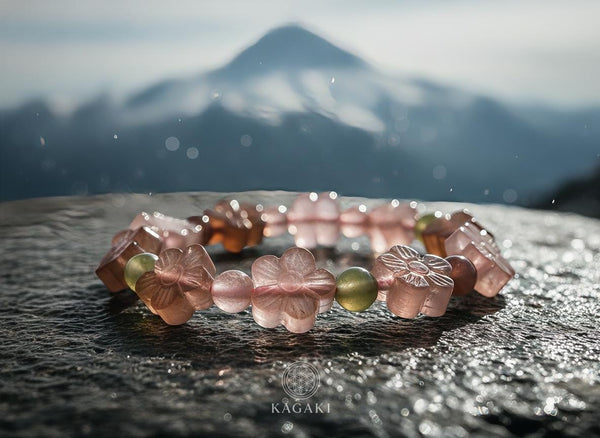
Field – 野 | Flower Agate Jade Bracelet
Flower agate with jade — a piece that can stand on its own.
View the bracelet →
Lilac – 菫 | Lavender Jade Beaded Stretch Bracelet
Lavender jade, for the quieter end of the stone.
View the bracelet →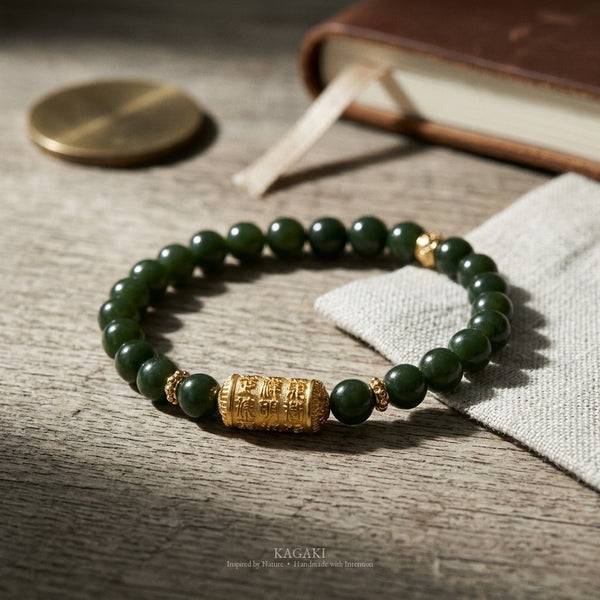
Or browse the jade bracelet collection.
Q: What does it mean when a jade bracelet breaks? A: In Chinese tradition, a jade bracelet that breaks is often said to have absorbed misfortune — taking the blow that would otherwise have reached the wearer. The reading is interpretive, not literal. Some people keep the broken pieces as a kind of quiet thank-you; others have the bracelet re-strung or buried. There is no required response.
Q: Which wrist should you wear a jade bracelet on? A: There is no strict rule. Some traditions associate the left wrist with receiving energy and the right with releasing it; others reverse this. The honest answer is: wear it on the wrist that feels right for your hand dominance and daily rhythm — the bracelet will move with you either way.
Q: Are dyed jade bracelets still meaningful? A: Yes, with honesty. A dyed jade bracelet carries the same handmade gesture as natural jade — the cord, the knot, the daily wearing. What changes is the cultural-value claim: dyed jade should not be sold as natural jade. As a symbolic piece worn for its color and feeling, dyed jade is a valid choice as long as it's described as what it is.
Q: What color jade bracelet should I choose? A: Start with the color you keep returning to. Green for steadiness and inheritance, white for clarity and beginning, lavender for softness and dream, black for protection and grounding, pink for tenderness, yellow for warmth and abundance. The body chooses before the mind names the reason.