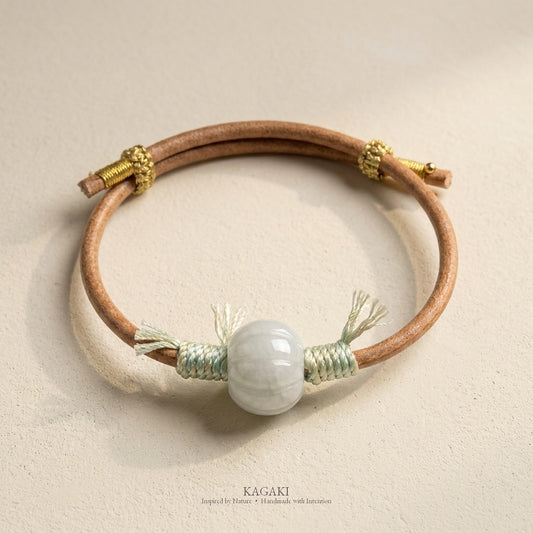
Hold one of these beads up to a window and the green refuses to settle. At the edge it goes nearly black; turned a little, a pale vein runs through it the way light runs through a leaf you hadn't noticed was thin. Lichen on a fence post. Old celadon glaze. Water remembering the stone it passed over.
Twenty-one pieces are gathered here, $15.77 to $49.77. All but two are nephrite — spinach-green, celadon, grey-green, teal, deep green — and two are jadeite; a few arrive with agate, turquoise or quartz beside them. KAGAKI's other jade is grouped by its own colour, lavender, pink, white. This page keeps one colour and lets the form wander: stretch bracelets on elastic, a charm bracelet on braided cord, necklaces on braided cord, leather cord, sandalwood or gold-tone chain, a beaded ring, a small cat-paw charm. In East Asian traditions green jade carries associations of harmony and long life — a history we stand beside as students of it, not as authorities on it. Nearer to hand, sorting these beads under a desk lamp, the association makes a plain kind of sense: green is the colour of a thing still going on.
Questions about these pieces
What kind of jade is this?
Nineteen of the twenty-one pieces here are nephrite; two are jadeite. Those are the two mineral species the word jade properly covers, and each product page lists its own materials. The colour runs from spinach-green through celadon, grey-green, teal and deep green, with a few pieces set beside agate, tourmaline or quartz. KAGAKI is a small handmade studio rather than a gem laboratory: what we state is the mineral and the colour. No grading or laboratory paperwork sits behind these pieces, and we claim none.
How is it sized, and will it fit?
Several of the bracelets here are strung on elastic, so they slide over the hand rather than fastening. The braided-cord and leather-cord pieces are knotted by hand, which is part of why no two come out quite identical. Necklaces come on braided cord, leather cord, sandalwood or gold-tone chain. Length, bead diameter and whether a piece has any give differ from one to the next, and we do not publish those numbers, so there is nothing on this page to size yourself against — if a measurement matters to you, write to the studio before ordering and the actual piece can be measured for you.
How do I care for green jade?
Take it off before showering, swimming and sleeping where you can, and keep lotion, perfume and cleaning products away from both stone and cord. Store it flat or loosely coiled, out of long hours of direct sun. Elastic softens and braided cord relaxes with wear, and sandalwood tends to darken a little where it sits against skin. The nephrite itself is hard and takes the handling well; it warms to you and holds that warmth, which is the part people tend to notice. None of that is the piece failing — it is the piece ageing with you.
Is it handmade, and where?
KAGAKI is a small studio in Hollywood, California, and the making happens there: cord measured and cut by hand, beads chosen one at a time, knots tied at the speed a person can tie them, each piece packed into soft paper at a desk. The stone itself is sourced rather than quarried by us, and where a particular bead came out of the ground is not something we can trace, so we do not say. What we can say is that small variations come with hand work. A knot sits slightly differently on one bracelet than on another, and no two nephrite beads carry quite the same vein.